There is a particular kind of frustration that only large companies understand.
You might have a paid media agency managing campaigns, an SEO consultant focused on rankings, a freelance copywriter producing content, an internal brand team overseeing messaging, and a web developer on retainer handling site updates. On top of that, a marketing director is often responsible for keeping all of these moving pieces aligned. Yet despite the investment and effort from multiple specialists, overall marketing performance can still feel inconsistent.
If you are nodding along, you are not the only one.
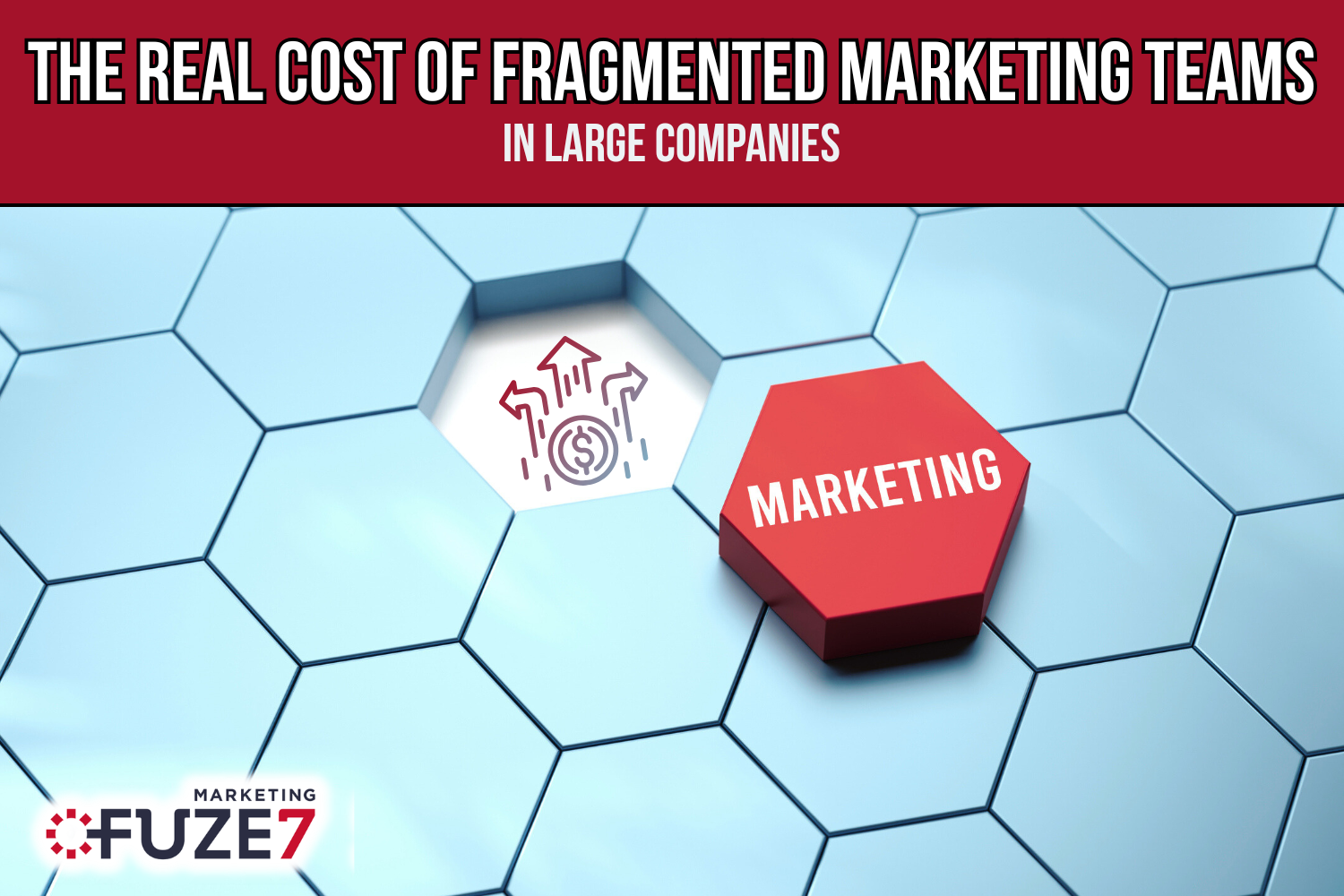
Fragmented marketing teams are common in enterprise organizations. What begins as a reasonable decision to hire specialists often evolves into disconnected strategies, duplicated efforts, inconsistent messaging, and rising costs that are hard to justify in quarterly reports. The issue is rarely talent. The issue is structure.
In this blog, we take a closer look at the hidden cost of marketing fragmentation and the steps leaders are taking to solve it.
When Everyone Owns a Piece, No One Owns the Outcome
One of the biggest indicators of fragmented marketing teams gone wrong is this simple question: Who owns the result?
If your SEO team focuses on rankings, your paid media partner reports on cost per click, your content team tracks engagement, and your internal stakeholders look at revenue, who focuses on the overall return on investment? Each group measures success differently.
The problem is not the metrics. The problem is alignment.
Without an integrated digital marketing strategy, teams optimize for their channel rather than for overall business growth. An enterprise marketing strategy should function like a single engine, not a collection of separate parts.
If you are spending heavily on marketing but struggling to link activity to revenue, a conversation about consolidating the marketing team may be overdue. Marketing ROI for large companies is a priority, and pivoting quickly is vital.
The Financial Cost of Disconnected Execution
Enterprise marketing budgets are not small. That makes inefficiency expensive.
Here are common scenarios large organizations face:
- Paid campaigns drive traffic to landing pages where SEO has not been optimized
- Content is created without input from search data
- Brand messaging varies between departments
- Reporting dashboards conflict with one another
These issues seem minor individually. Together, they create a slow leak in your marketing ROI that can build substantially over time
An integrated marketing agency model eliminates duplicated efforts and aligns your marketing channels under one strategic vision. Instead of multiple vendors billing for overlapping services, your investment flows toward coordinated growth.
Many enterprise leaders discover that marketing team consolidation actually reduces costs while improving performance, resulting in fewer silos, fewer repeated meetings, and fewer conflicting priorities.
The Strategic Cost of Slow Decision Making
Large organizations already move carefully. That is part of responsible leadership. But fragmented marketing teams add another layer of delay.
Imagine this scenario:
Your SEO partner identifies a content opportunity. Your web team needs two weeks to update templates. Your brand team wants revisions. Your paid media partner is unaware of the timeline. By the time the content launches, the opportunity has shifted.
This is where enterprise marketing solutions must go beyond execution. They must improve marketing workflow efficiency.
When one unified team manages SEO, content marketing for enterprises, paid media, and website development, decisions happen faster. Strategy evolves in real time. Opportunities are not lost to internal friction.
Marketing workflow efficiency is not glamorous, but it is powerful. The faster your organization can adapt, the stronger your competitive position becomes.
The Human Cost of Overextended Leadership
Many owners, CEOs, and founders in large companies do not want to manage marketing vendors. They want results. They want clarity. They want one accountable partner who understands the full picture.
If you are too busy running operations, managing investors, or scaling infrastructure, marketing oversight becomes reactive. You step in when something breaks, not when something needs to grow.
In contrast, a unified digital marketing strategy supported by an integrated marketing agency allows leadership to step back without losing control with one strategic partner, one reporting system, and one roadmap.
The time you save is often more valuable than the budget you spend.
The Brand Cost of Inconsistent Messaging
Enterprise organizations often struggle with brand drift.
Different teams interpret messaging differently. One campaign leans technical. Another sounds conversational. A third feels outdated. Customers notice, even if internal teams do not.
Content marketing for enterprises requires consistency across platforms, regions, and departments. That consistency is nearly impossible when marketing teams operate independently.
An integrated marketing agency ensures that SEO, paid media, web design, and content development all reinforce the same positioning. This strengthens authority and improves conversion rates.
Brand clarity compounds over time. Confusion compounds faster. Choose clarity over confusion.
The Performance Cost of Siloed Data
If your SEO reports live on one platform, your paid media data on another, and your CRM insights elsewhere, leadership never sees a full picture.
Enterprise marketing solutions must connect performance across channels. Organic traffic should inform paid targeting. Paid campaigns should reveal content gaps. Website analytics should influence future strategy.
When marketing team consolidation happens, reporting becomes unified. Instead of siloed data updates, you receive integrated insight tied directly to business goals.
That clear direction improves forecasting, budgeting, and board-level communication.
What a Unified Model Looks Like
An integrated marketing agency does not replace your internal team. It strengthens it.
Here is what changes when fragmentation ends:
- One digital marketing strategy governs every channel
- Messaging remains consistent across campaigns
- Marketing workflow efficiency improves
- Data is centralized and actionable
- Leadership communicates with one strategic partner
Fuze7 Marketing works with enterprise organizations that are ready to simplify complexity. Our enterprise marketing solutions are designed for companies with scale, multiple departments, and ambitious growth goals. Instead of managing five vendors, you manage one team that coordinates everything.
If any of the issues described here sound familiar, it is a signal that your structure needs refinement.
Bringing It All Together
Fragmented marketing teams rarely fail because of talent.
They struggle because coordination at scale is difficult. The larger the organization, the greater the risk of silos forming among SEO, content marketing for enterprises, paid media, and web development.
The hidden cost is not just financial. It is strategic. It slows decision-making, dilutes messaging, and drains executive focus.
If your organization is ready for marketing team consolidation and a clearer path forward, Fuze7 Marketing can serve as your integrated marketing agency partner. We help enterprise leaders replace fragmented systems with unified execution, stronger reporting, and a digital marketing strategy built for measurable growth.
Contact us to get started.